
Itawamba County Criminal Docket Searches
Start with the court that received the charge. Felonies, indictments, pleas, and lower-court appeals belong to the Itawamba County Circuit Clerk. Those Circuit files may also sit in Mississippi Electronic Courts, known as MEC, through its paid public layer, PAMEC. Misdemeanors, warrants, bonds, and preliminary hearings run through Itawamba Justice Court. City ordinance and city traffic charges stay with the municipal court named on the ticket.
A case number from a notice is the fastest path in. Use it exactly. No official Itawamba page publishes a single Circuit criminal case-number pattern. The MEC screen you see before logging in does not show its search fields. A name can help once you have access. Court, county, and charge level narrow things first. When nothing comes back, the file may be in Justice Court, a city court, an older paper file, or a restricted record.
- Read the notice or charging paper for the court name and case number.
- For a Circuit felony, use PAMEC or contact the Circuit Clerk for the docket route.
- For a Justice Court matter, identify whether it is East Side or West Side and call the court clerk.
- For a Fulton, Mantachie, or Tremont city case, contact the issuing municipality because no public city docket search was located.
- Confirm any current setting or requested copy with the custodian before relying on it.
Itawamba Criminal Docket Access
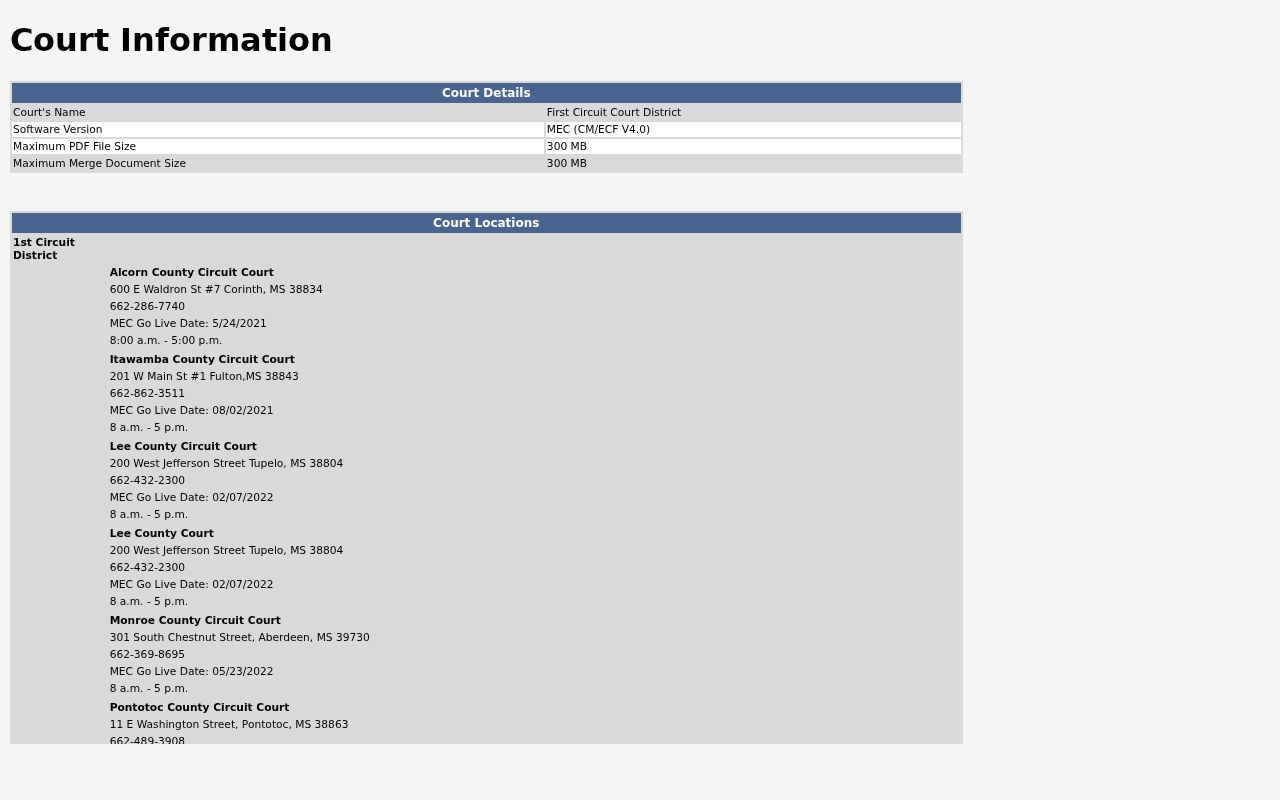
The First Circuit MEC entry is the electronic filing and docket system. It serves the district covering Itawamba Circuit Court. Per the court-information record, Itawamba Circuit went live on MEC on August 2, 2021. That explains a common split. Newer Circuit matters are electronic, while older records may still need clerk help. Availability of documents still follows court rules and restrictions. The First Circuit MEC landing screen is where the district system begins.
Remote viewing runs through PAMEC, not an open county name-search box. The PAMEC registration route shows a $10 annual fee for a non-attorney account. After that, terms charge $0.20 per result page, even when a search returns no match. So keep queries tight. Need a paper file? Ask the clerk's office. The clerk is also the practical fallback for a record older than electronic filing or a question about public viewing.
Criminal Dockets: What They Show
A criminal docket is a running court record, not a retelling of every fact. The Circuit Clerk describes its general court docket. It records names and parties, pleas, indictments, lower-court appeals, and papers referenced to the minute book. An authenticated MEC result can add a docket sheet plus whatever documents are public. A live criminal sample is not viewable without PAMEC access. The fields that follow reflect that split. They separate expected docket information from details the public screen does not expose.
| Case number | The court-assigned identifier. The local published format was not located, so use the exact number shown on a notice rather than assuming a pattern such as 2026-CR-00001. |
|---|---|
| Header and parties | Court, filing date, caption, party roles, and judge when the docket displays them. |
| Charge and filings | Charge information, indictment or plea entries, motions, notices, and orders may appear in chronological order. |
| Settings | Arraignment, pretrial, plea, or trial activity, plus any continuance or reset language. |
| Status and result | Flags and entries can show a pending event, disposition, sentencing stage, appeal, closure, or access restriction. |
Always pair the event date with the entry's own text. A calendar term can help you locate a session. It does not replace the case docket, the filed order, or the final judgment.
Itawamba Criminal Docket Flags
The local First Circuit MEC Court Information page gives a real flag inventory. It covers Itawamba Circuit cases. Labels there include BOUND OVER, Arraignment Pending, Trial Pending, Plea Pending, SENTENCE PENDING, and DEFERRED SENTENCING. Other labels are CLOSED, SEALED, EXPUNGED, Nolle Pros Pending, Probation, and REDUCED TO MISDEMEANOR. Treat any flag as an operational marker, nothing more. Read it with the case entries and any order the file contains. The Circuit MEC Court Information screen sets out the local court location. It also lists status vocabulary and system details.
Take BOUND OVER. It signals movement from a lower court toward Circuit Court. Arraignment Pending means that step simply has not happened yet. Nolle Pros Pending means the action is incomplete. CLOSED marks a closed case status, while SENTENCE PENDING or DEFERRED SENTENCING points to a remaining or delayed sentencing stage. No flag alone settles the final outcome.
- Capias Pending
- A capias process remains pending. A capias directs law enforcement to bring a person before the court.
- BOUND OVER
- A lower-court matter has moved toward Circuit Court for the next stage.
- Nolle Pros Pending
- The prosecuting side has a nolle prosequi action pending, meaning a decision not to prosecute has not yet been completed on the docket.
- REDUCED TO MISDEMEANOR
- The MEC flag identifies a reduced charge classification. Confirm the order or docket entry for the exact action.
Criminal Case Stages on the Docket
A county criminal record often starts small. Justice Court or Municipal Court may handle the charging event. The same court can hold a preliminary hearing. It can also set a bond. A felony can then be bound over or reach Circuit Court by indictment. From there the Circuit docket may show arraignment, motions, notices, a plea term, and a trial term. Later it may record a disposition and sentencing or appeal activity. Each entry answers a narrower question than the label "criminal case" implies.
Docket flow: Filing → Arraignment → Pretrial → Plea or Trial → Disposition → Sentencing
Under the Mississippi Rules of Criminal Procedure, a trial-setting order is to be entered within 60 days after arraignment or waiver, and trial is to occur no later than 270 days after arraignment or waiver, subject to continuances. The rules give timing context. A case-specific order, continuance, or calendar change still controls the actual setting.
Itawamba Criminal Docket Terms
Itawamba County criminal cases run on court terms, not one steady calendar. The First Circuit's 2024 calendar list lays out those terms for the year. It includes the special "Plea(s)" terms the court sets aside. It also reveals a quirk worth knowing. Civil and criminal terms can be double-booked on the same dates. So a term date alone tells you very little about a specific case setting. Treat the calendar as structure, not as a substitute for the docket sheet itself.
The First Circuit calendar posted online comes with its own cautions. Registration is required to view it. The court warns that it carries general information. It may omit settings, and it can change without notice. If a term looks like it matches your case, compare it against the docket sheet. Then confirm with the Circuit Clerk or Court Administrator. A listed term never guarantees that a hearing will actually happen at that time.
A calendar entry points to a likely court session. The docket plus a current clerk confirmation gives the safer, case-specific answer.
Itawamba County Criminal Docket Courts
Where a criminal docket lives depends on the charge. Itawamba County Circuit Court handles felony prosecutions. The Circuit Clerk keeps the general court docket for those cases. Justice Court takes misdemeanor criminal cases, plus preliminary hearings, bonds, and warrants. Municipal Courts cover city ordinance violations, municipal misdemeanors, and city traffic tickets. One wrinkle trips people up. An appeal or a bound-over matter creates a new or related Circuit Court record. So the earlier court file may not hold every later event.
Circuit Clerk Ceburn Gray sits at 201 W. Main St. #1 in Fulton. The office is reachable at 662-862-3511. That office is separate from Justice Court. A person chasing a misdemeanor or preliminary record should not assume the courthouse counter holds the Justice Court file. Ask the right office first.
| Court route | Criminal docket role | Local contact |
|---|---|---|
| Circuit Court | Felonies, indictments, pleas, and lower-court appeals. | 201 W. Main St. #1, Fulton; 662-862-3511. |
| Justice Court | Misdemeanors, preliminary hearings, bonds, warrants, and some traffic matters. | 104 Joe Staub Rd., Fulton; 662-862-4315. |
| Municipal Court | City ordinance, municipal misdemeanor, and city traffic matters. | Fulton 662-862-4929; Mantachie 662-282-7949; Tremont 662-652-3366. |
Itawamba Criminal Court Tuesdays
Justice Court does not run through the Circuit Clerk's office at the courthouse. Itawamba County schedules criminal court for the second and fourth Tuesday of each month. The docket is split into East Side and West Side divisions. That pattern helps you place a misdemeanor, bond, warrant, or preliminary matter in time. But the county page offers no general public case-search database and no current case list. For a docket answer, pick up the phone.
Call the Justice Court clerk at 662-862-4315 with the case number or citation details handy. Give the clerk the case type and division so nothing gets confused. A city charge is different. That call goes to the city instead. Fulton, Mantachie, and Tremont post no official online public docket. So the municipal contacts are the direct record route. A fruitless MEC search proves nothing about those courts.
The First Judicial District Adult Felony Intervention Court serves Itawamba along with six other counties. Its drug court program page is informational only. It does not replace the Circuit Court docket. Program participation and the underlying circuit case record are two separate questions.
Access Rules for Criminal Dockets
Mississippi public-record rules back your right to inspect and copy non-exempt records through reasonable procedures. Court rules and confidentiality law can still wall off particular files. For an official copy of anything, the clerk keeping the case beats every other source. PAMEC sells remote access to electronic, non-restricted docket sheets, notices, and documents in participating courts. Even so, coverage has gaps. Paper files, city courts, and Justice Court matters may never show up there online. The same goes for older Circuit records.
Key rules:
Miss. Code Ann. §§ 25-61-2 and 25-61-5 recognize access to non-exempt public records for inspection, copying, or reproduction under reasonable written procedures.
Miss. Code Ann. § 25-61-7 permits charges reasonably calculated for searching, reviewing, duplicating, and mailing records.
Miss. Code Ann. § 25-61-11 preserves confidentiality imposed by constitutional, statutory, or judicial rules.
Miss. Code Ann. § 43-21-255 recognizes special confidentiality protections for many records involving children.
Itawamba Criminal Docket Restrictions
Local MEC flags include SEALED, Sealed_Case, and EXPUNGED. Seeing a flag does not mean you can read the underlying document. The MEC login notice warns that some documents go only to attorneys of record. Others are limited to recognized accounts. Filing rules also protect certain identifiers. Those include Social Security and taxpayer numbers, dates of birth, minor-child names, financial-account numbers, and home addresses.
A case missing from PAMEC is not proof of sealing or expungement. The matter might sit in Justice Court, Municipal Court, or another county. It could be a legacy paper file, or a later appeal file. For your own sealed or expunged matter, ask the clerk maintaining the court file. Ask which petition, notice, hearing, and fee apply. The county publishes no Itawamba expungement filing fee, so assume no amount without asking.
A docket status can signal that access is limited. Only the responsible court or clerk can explain the current scope of public access.