
Itawamba County Court Record Requests
The right route depends on the court and on which record layer you want. Circuit papers start with the Circuit Clerk or First Circuit PAMEC. Chancery papers start with the Chancery Clerk or First Chancery PAMEC. Justice Court posts no general online document repository. Those requests go straight to the court. Municipal requests belong with the city custodian for the city named on the case paper. The county also keeps a written-records route for county records. An office may direct that procedure instead.
- Identify the court, case number, party names, record type, and whether a plain or certified copy is needed.
- Use PAMEC for an eligible electronic Circuit or Chancery file, or contact the court custodian for Justice and municipal matters.
- For clerk access, call first to ask whether the item is electronic, paper, archived, sealed, or subject to an order.
- Visit the office during regular business hours for available free electronic viewing, subject to local limits and copy fees.
- Submit a county written request by mail, hand delivery, email, or fax to the Chancery Clerk when that county process applies.
- Confirm the current copy, certification, search, and delivery charges before payment or a trip to the office.
The county sets a seven-day expectation for a response under its public-records procedure. That window covers the reply, not a guaranteed production date when a request is large, archived, or restricted.
Itawamba County Court Record Custodians
Custody here is split among several offices. The Circuit Court holds the general court docket. It also holds felony filings, civil law cases, and lower-court appeals. Chancery keeps minute books. It also keeps the equity, family, probate, land, guardianship, adoption, and Youth Court side of things. Justice Court and each municipality maintain separate records of their own. Asking the wrong counter only adds delay. Match the file to its clerk before you file the request.
Itawamba County Circuit Clerk
Ceburn Gray
201 W. Main St. #1
Fulton, MS 38843
662-862-3511
cgray@itawamba.gov
Itawamba County Chancery Clerk
Michelle Clouse
201 W. Main St. #4
Fulton, MS 38843
662-862-3931
mclouse@itawamba.gov
Itawamba County Justice Court
104 Joe Staub Road
Fulton, MS 38843
662-862-4315
Call for Justice Court records and the current court-file process.
Both the Circuit and Chancery offices work out of the courthouse at 201 West Main Street, though their rooms and their records differ. City case papers should go to the municipal clerk rather than either courthouse counter.
Kinds of Court Records
Keep four record layers straight. A docket sheet or register is the chronological list of case events. A filed document is the complaint, petition, motion, order, judgment, indictment, or other paper. It sits behind one of those entries. A calendar looks forward and lists settings. A recorded instrument or administrative record may sit with the clerk. Yet it may not be a court case at all.
- Docket sheets listing filings, notices, hearings, orders, and status events.
- Filed Circuit papers such as pleas, indictments, appeal papers, and documents referenced to the minute book.
- Chancery minute books, proceedings, bills, petitions, motions, accounts, and inventories.
- Calendar or setting records that show an upcoming hearing but not the full case history.
- Justice Court and municipal case papers held outside the published PAMEC routes.
- Land instruments and other administrative material that should not be confused with a court docket.
Say which layer you want in the request. Asking for "the record" can mean very different things to the clerk and may never identify the copy you actually need.
Itawamba County Docket and Documents
The Circuit Clerk describes its general court docket. It holds party names, pleas, indictments, lower-court records on appeal, and other papers referenced to the minute book. The Chancery Clerk's description covers minute books and proceedings, bills, petitions, motions, accounts, and inventories. So the docket tracks activity in the case. A document request is different. It seeks the actual filing or official copy behind a docket line.
A calendar entry is its own thing. It may show a date, time, Cause #, county, caption, attorneys, the nature of the matter, and estimated time. Yet it is neither the full chronological docket nor a document repository. When someone needs the signed order after a hearing, the request should name that order and its court file. Naming only the calendar date will not do.
Note: A transcript is also different from a docket printout, minute-book entry, or filed order. It has its own custodian and fee process.
Court Records: What They Contain
What you can see in a record depends on the court and the access channel. The electronic docket usually shows a case header and a chronological list of events. The file itself holds the papers tied to those events. A public Chancery setting page gives only a narrower calendar view. Itawamba County publishes no universal case-number format. The exact number from the court paper remains the safest identifier for any docket search.
| Case number | The court-assigned identifier. The county-wide format is not published, so copy it exactly from the notice or prior record. |
|---|---|
| Case header | Court, caption or parties, filing date, case type, status, and judge when the source makes them available. |
| Docket sheet | A chronological register of filings, notices, motions, orders, hearings, continuances, judgments, and dispositions. |
| Filed documents | The pleadings, orders, judgments, petitions, motions, indictments, or other papers associated with docket entries. |
| Settings | Date, time, judge or court, setting type, and continuation or reset language where shown. |
| Restrictions | Redacted fields, sealed status, or a document-access limit can reduce what a public copy shows. |
A record can look incomplete online even so. The clerk may still hold the underlying paper, or the item may sit in a restricted electronic layer the public account cannot reach.
Itawamba County PAMEC Court Records
PAMEC lets registered public users reach electronic documents, docket sheets, and notices remotely. The courts must be participating and non-restricted. It covers eligible Circuit and Chancery material, not every local court or every filing. A docket can be visible. A document may still stay counsel-only, restricted, unscanned, or otherwise closed to the account.
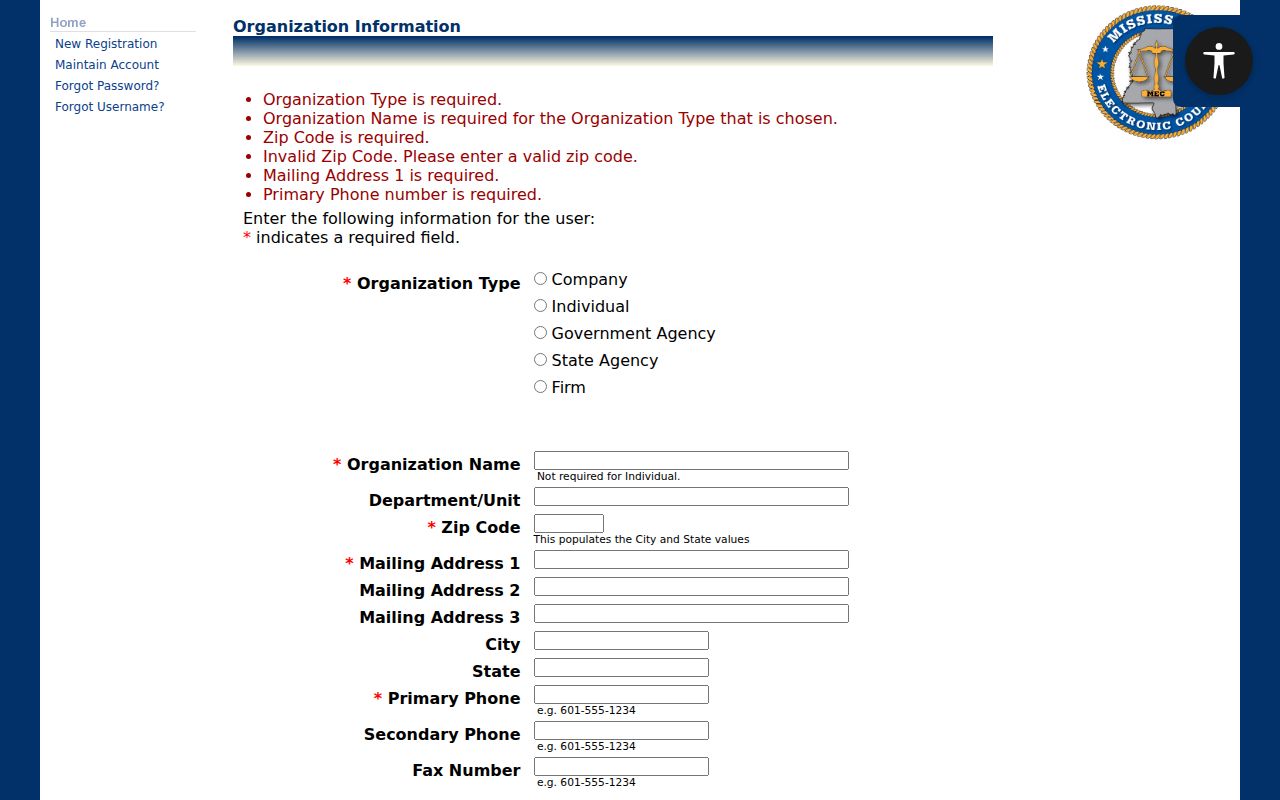
The organization path in PAMEC belongs to account creation, not to a public records request. It offers organization-type options such as Company, Individual, Government Agency, State Agency, and Firm. Those fields set up a remote account. They do not decide whether a particular court document is public.
PAMEC's organization-information form shows the account categories and contact fields.
Copy Fees and Certification
A plain copy, a certified copy, and a transcript are three different products. The county publishes no current court-copy fee, certification fee, or reporter transcript schedule. Do not assume the land-record portal charge is a court-record fee. Ask the custodian which product you need. Ask who can certify it and the current price before you order.
| Item | Published amount or timing |
|---|---|
| PAMEC annual public account | $10 annual registration for Attorney and Non-Attorney accounts. |
| PAMEC search results | $0.20 per result page; a no-match search is one charged page; quarterly billing applies. |
| County public-record request | Seven-day response statement; exact copy-fee lines were not reliably extracted from the county PDF. |
| Certified court copy | Current fee not located in accessible official county sources. Confirm with the custodian. |
| Clerk-file copy or transcript | Current fee not located in official sources reviewed. Request a fee quote before ordering. |
| Online land-index service fee | 3.5%, $2 minimum, non-refundable. This is a portal service fee, not a stated court-record fee. |
Official MEC viewing in the clerk's office is free during regular business hours under the administrative procedures. Local limits still apply, and any requested reproduction can carry its own copy charge.
Itawamba County Record Request Route
Itawamba County keeps its local rules in one place. That place is the public-record request policy and fee schedule. That PDF controls the form you file and the fees you pay. The Chancery Clerk takes written requests by mail, hand delivery, email, or fax. The address is 201 W. Main St., Fulton, MS 38843. No account or login is needed on that path.
Call before you file. The office number is 662-862-3931. The staff can confirm the form's current fields, where to send it, and any charge. The policy's seven-day statement sets a response expectation only. A complex file can take longer, and that deadline never promises automatic delivery. Treat the three-page form as something to confirm. Do not guess at it; ask the clerk instead.
Itawamba County Land Record Index
A land instrument can be traced through the county land-record portal. That index is not the official courthouse record. It is not a court-docket search either. When legal effect or a chain of title matters, verify the actual instrument with the office that recorded it.
One fee warning deserves attention. The portal charges a 3.5 percent service fee with a $2 minimum. That fee is non-refundable. It belongs to the online land index alone. A Circuit, Chancery, Justice, or municipal court copy carries its own rates. So keep land records and court files separate when you search and when you talk fees.
Itawamba County Court Record Security
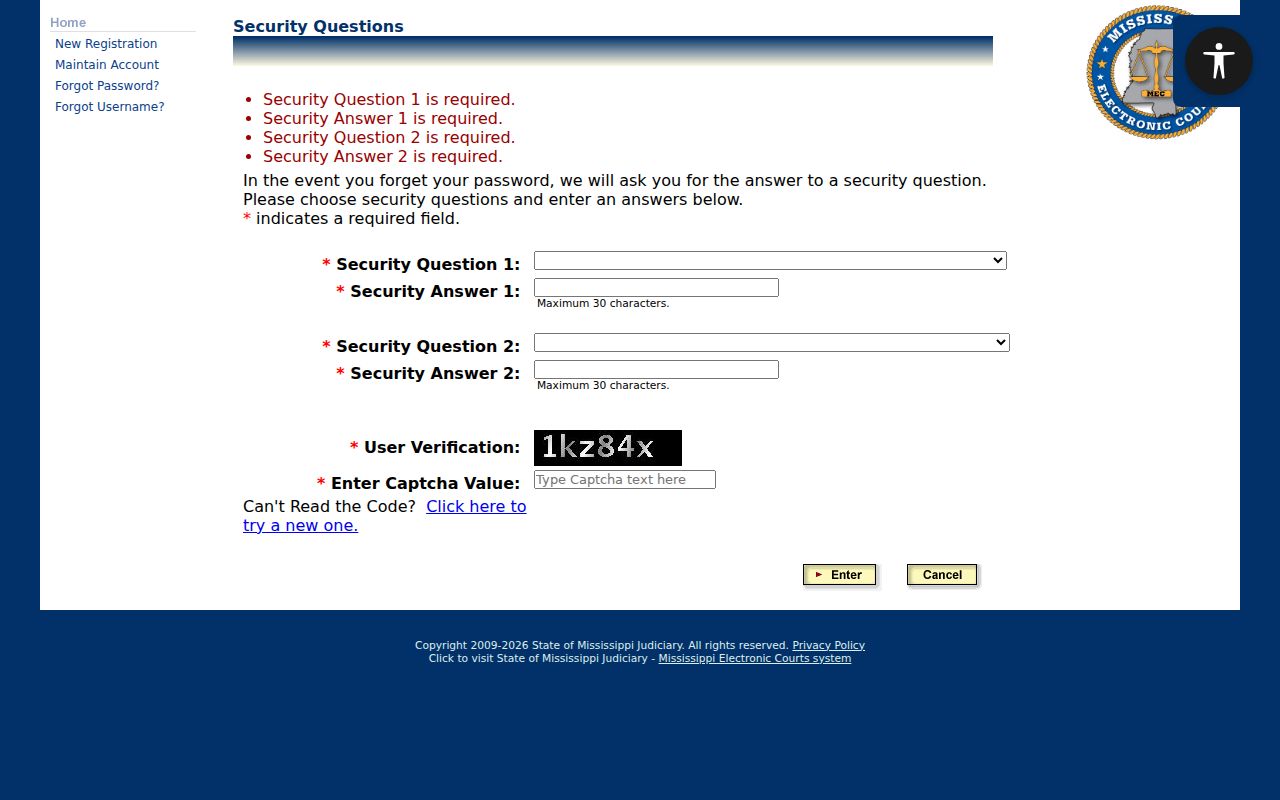
PAMEC's remote access adds a security-question step before you get near a court docket. The form demands two security-question selections. It also demands two answers capped at 30 characters each. A verification image and a required CAPTCHA value round it out. None of that is a case-search result; it is simply one more registration screen.
The screen confirms what electronic access really is here: account-based. Account rules do not erase the court-level limits. Sealed files, restricted documents, and protected identifiers all stay restricted at the court level.
PAMEC's security-question form shows the two-question and CAPTCHA requirements.
Access Rules for Court Records
Mississippi law leans toward openness. The judiciary's openness policy backs public access. So does the Mississippi Public Records Act. Both are bounded by court rules, confidentiality laws, and court orders. In practice, you start with the clerk who holds the file. That may be the Circuit Clerk, the Chancery Clerk, Justice Court, or a municipal custodian. Each keeps a different slice of the court records. One caution applies to anything you pull up remotely. An online result is not automatically the certified official record.
Mississippi public-record rules.
Judiciary openness policy recognizes open judicial records while preserving court rules, confidential records, and court orders.
Miss. Code Ann. §§25-61-2 and 25-61-5 state the public right to inspect, copy, or reproduce non-exempt records under reasonable procedures.
Miss. Code Ann. §25-61-7 permits reasonable costs for searching, reviewing, duplicating, and mailing.
Miss. Code Ann. §25-61-10 addresses electronic access and redaction; §25-61-11 preserves statutory, judicial, and privileged exceptions.
Miss. Code Ann. §43-21-255 makes Youth Court and related child records generally confidential, subject to stated exceptions.
A public-facing status marker on a case does not mean everything is viewable. Sealed, youth, adoption, and protected-identifier material can be missing, redacted, or limited even then.
Itawamba County Records Access Check
Some groundwork saves time before any records request. Name the court and the record layer. Keep the exact case number handy. Also ask whether the matter sits in an electronic system, a paper file, an archive, or a sealed or restricted status. The 2021 MEC go-live dates for Circuit and Chancery work as archive boundaries. They are not proof that older cases are gone. A record missing from remote search may just need a clerk's eyes. Try that before another broad query.
Match the route to the court. A docket result that needs a filed paper goes through that court's clerk. A Justice or municipal file starts with the court itself. For electronic Circuit or Chancery work, the Itawamba County docket search route walks through PAMEC registration. It also covers its result-page charges. Whatever path you take, confirm the current record with the office that maintains it.